


 Turntable Accessories
 Headphone Accessories
 Cable Accessories
 Vinyl Accessories
 Compact Disc Accessories

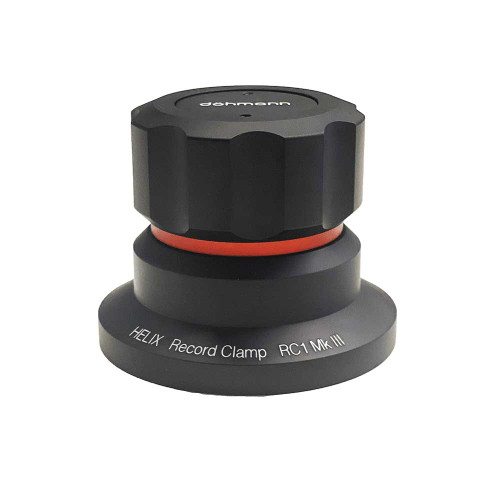
This product can only be shipped to U.S. addresses.
At the core of Döhmann Audio's philosophy is the study of resonance energy in analog playback systems. In 2020, Döhmann Audio's R&D Lab acquired a new piece of test equipment that enabled them to measure resonance propagation and behavior with a significantly higher accuracy and resolution than ever before. The period of research that followed resulted in some discoveries and insights that led to the development of the Mk3 technologies.
The Mk3 Record Clamp is the result of extensive research, data analysis and resonance profile modeling. It represents a significant step forward in analog system design, incorporating new technologies that have never been used in audio applications before. It is difficult to imagine the difference a record clamp can make to the sonic presentation and performance of a turntable; however, the proof is in the listening. Without being aware of it, most of our sound quality reference moments have been experienced in the presence of record & spindle resonances. Remove them, and the paradigm shifts again.
The Mk3 Record Clamp has been designed with three principles in mind:
1st Principle – Record Resonance
Vibrations are present in the vinyl medium itself, both originating externally from sound waves in the air and from the mechanical systems in the record player. They also originate 'internally' from the interaction between the stylus and the record grooves. However, utilizing the latest technology, Döhmann Audio were not only able to measure this resonance, but also observe how it travels within the vinyl medium. This led to a critical thought process on how to attenuate these "self-chatter" resonances using a properly executed clamp design. To address the challenge of record-originating resonances, the new Döhmann Audio Mk3 Record Clamp has the following features:
- Large mating (damping) contact surface area for the new clamp design to work as opposed to using high force contact points like a spike or ball bearing.
- Metallurgy was specifically chosen for transmission purposes with internal chambers used for the critical damping materials. One material cannot provide the broad frequency spectrum needed – it needs to be a carefully selected group of materials.
- Compact design to lower the profile and impact on bearing precession.
2nd Principle – Spindle Resonance
Döhmann Audio measured resonances through the spindle (stem) which originate in the bearing. These frequencies need to be addressed by different tuned materials and the upper section of the clamp has its own purpose-designed chambers to allow addition of specialized polymers.
3rd Principle – Isolation of the Record from the Spindle Resonance
Döhmann Audio realized that mitigating spindle resonance helped, but in order to achieve the best sonic results, they had to keep those resonances completely away from the record. To achieve this, a third constrained layer ring system is used to separate the upper and lower chambers, which under clamping pressure creates a dissipation plate (Finite Element Method) that is shaped carefully to provide an optimum boundary interface.
The cumulative outcome from addressing these challenges is a discernible improvement in clarity, resolution, focus, dynamic contrasts and tonality within the sonic presentation of a turntable. Although this record clamp was designed as part of the Döhmann Audio Mk3 project, it has been consistently demonstrated that this product will improve the sound quality of any turntable that it is used in conjunction with.
This clamp design is a result of close collaboration within the team working at Döhmann Audio and their tight relationships with engineering and materials science leaders in the university and defense/industrial sectors. Without advanced knowledge of new materials and customization capabilities, such breakthroughs would not be possible.
Döhmann Audio hopes that the new Mk3 record clamp assists you to enjoy your vinyl music collection with greater emotional connection
The Döhmann Audio Helix RC1 Mk.III does raise some serious questions about analog rigs in general. For instance, if you've previously balked at using record weights and clamps because you don't hear a difference, the Döhmann will undoubtedly change your mind. In addition, the success of this design opens up Pandora's box–are we going to keep hearing substantial improvements in our hi-fi system if we take a look at every single thing in the analog playback chain? As an audiophile, you should already know that's true.
As it stands right now, I've never heard a record weight or clamp make this much of a difference during A/B comparisons. A more apt conclusion can be drawn, however, if you simply live with the Döhmann Audio Helix RC1 Mk.III record weight for an extended period of time. When you take it out of your system, it should make you sad. That's what happened to me, anyway.
Highly recommended.
The most costly of the three by a considerable margin [the Döhmann RC1 Mk3] produced the biggest sonic difference. Blacker backgrounds, increased three-dimensionality, improved detail resolution and just more of everything in terms of texture, touch, harmonic structure and especially overall spatial and timbral stability. The funny thing is the Döhmann appears to be the most conventional and like just a weight, the other two more exotic, yet the proof was in the listening.



 FREE SHIPPING